Spray-On Consumer Products
The lower end of DIY protection with minimal surface preparation.

You’ve been quoted somewhere between $800 and $2,500 for ceramic coating, and you’re trying to figure out if that number makes any sense. The internet isn’t much help. Enthusiasts call it life-changing; skeptics call it overpriced wax. Both camps are partly right, and that’s the problem with most of the advice out there.
This article gives you a straight answer. We’ll cover what ceramic coating actually does to your paint, what it costs at every level, how long it holds up in the real world, and what maintenance it actually requires. By the end, you’ll know whether it’s the right call for your vehicle or whether something else makes more sense for your situation.
At ProTech Detailing AZ in Phoenix, we work with vehicles at every stage of paint deterioration. That ground-level view shapes everything in this breakdown. We see where ceramic coating earns its price and, just as clearly, where it doesn’t.
Ceramic coating is a nano-ceramic, semi-permanent liquid polymer that chemically bonds to your vehicle’s clear coat. Once cured, it creates a hydrophobic, UV-resistant layer that sits on top of your paint and changes how contaminants interact with the surface. This isn’t marketing language; the chemistry is documented. The protection benefits are measurable and well-documented in independent testing.
Helps defend against oxidation and color fading in high-sun markets.
Water, grime, bird droppings, and sap release more easily instead of bonding aggressively.
Acidic contaminants have less opportunity to etch into the clear coat before removal.
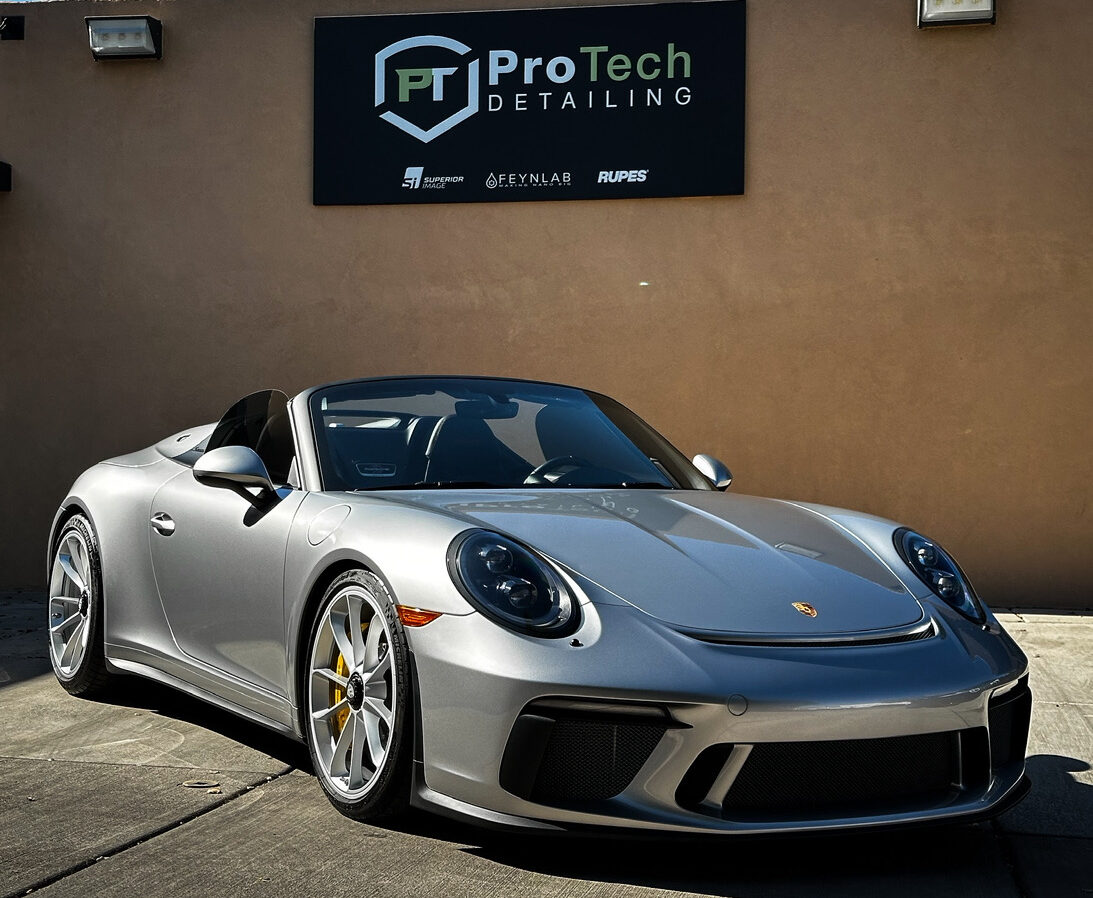
UV stabilization is one of the most practical benefits, especially in high-sun markets. The coating blocks UV rays that cause oxidation and color fading over time. The hydrophobic properties cause water, road grime, bird droppings, and tree sap to bead up and slide off the surface rather than bonding aggressively to the paint.
Chemical resistance means those same contaminants, many of which are acidic or corrosive, have far less opportunity to etch into the clear coat before you can wash them off. In an environment like Phoenix, where the UV index stays consistently among the highest in the country year-round and dust storms deposit abrasive particles on every unprotected panel, these aren’t small benefits.
Ceramic coating reduces micro-marring from washing and light incidental contact, but it is not a physical barrier. It will not stop a rock chip, a key scratch, or a door ding. PPF is designed for impact absorption. Ceramic coating and PPF protect against different threats, and the best setup for a new luxury vehicle is often both.
The price range isn’t arbitrary. It reflects real differences in product quality, surface area, prep time, and whether paint correction is included. Understanding what drives the number helps you evaluate any quote.
Consumer products commonly deliver 4–8 months for spray/wipe coatings or 12–20 months for better-prepared DIY applications. A budget option, but not the same product or process.
Professional 2026 pricing varies with coating layers, surface area, preparation, and paint condition.
Applying ceramic coating over scratched, swirled, or oxidized paint seals those defects permanently under the coating. Once it’s cured, those imperfections aren’t coming out without removing the coating first.
A single-stage correction adds roughly $300+ depending on size and condition; a multi-stage process runs $600+ depending on vehicle size and paint condition. For a midsize sedan that needs correction before coating, your realistic all-in investment is $900 to $1,400+. That number is accurate, and any installer who doesn’t bring it up in the consultation is skipping a step you’ll notice later. This number reflects a multi-stage correction on a mid size sedan with a 5 year FEYNLAB Ceramic Coating at ProTech Detailing.
Manufacturer warranty language is not the same as field performance. Product grade, application quality, surface preparation, and maintenance determine the honest range.
The lower end of DIY protection with minimal surface preparation.
Quality kits, proper preparation, good technique, and diligent maintenance can stretch performance.
Real-world field performance when professionally prepared, installed, and properly maintained.
Real-world testing places most graphene-enhanced coatings at 1–3 years, with professionally installed multi-layer systems occasionally performing longer. Application quality and maintenance matter more than the product label. Poor prep can collapse an expensive coating into sub-year performance, while proper care can extend a mid-tier coating well beyond its base warranty.
The most common misconception about ceramic coating is that it eliminates the need to wash your car. It doesn’t. What it does is make washing easier and less damaging. Skipping maintenance doesn’t just reduce gloss; it shortens the coating’s functional lifespan significantly.
Use a two-bucket hand wash with pH-neutral, ceramic-safe shampoo. One bucket holds shampoo; the other provides clean rinse water for the wash mitt between passes.
Brushes and high-pressure blowers degrade the coating faster and introduce new marring. Safe wash technique is the foundation, not an optional extra.
After each wash or every two to four weeks, a SiO2 maintenance spray can refresh hydrophobic behavior and gloss.
A ceramic booster or topper is appropriate when water beading begins to weaken.
An iron remover pulls bonded metallic contamination that builds invisibly and gradually reduces coating performance.
This is a manageable routine. It takes less time than frequent waxing, and the protection it maintains is significantly more durable. Skipping decontamination is a common reason professionally installed coatings underperform their rated lifespan—and it is easy to avoid with a consistent schedule.
The honest answer depends on your vehicle, environment, expectations, and willingness to maintain the finish.
ProTech Detailing AZ pursues certified installer status so that warranty documentation is tied to your vehicle’s VIN. Some certified installers offer VIN-registered warranties that can appear on vehicle history reports, giving a future buyer or dealership verifiable proof of professional care.
That kind of documented service record can support your asking price at trade-in time and give buyers added confidence in the vehicle’s condition. Not every shop structures its process this way, and most car owners don’t realize the difference until they’re already at the negotiating table.
Ceramic coating, PPF, sealants, and wax are not interchangeable. Each solves a different problem at a different price and durability level.
For new vehicles in harsh climates, professional ceramic coating is worth the investment when it’s properly applied over corrected paint and consistently maintained. For daily drivers who want lower long-term maintenance costs and a surface that resists contamination, the math is solid. For owners who care about resale documentation, a VIN-registered installation creates a verifiable service record you can point to at trade-in time.
For older vehicles, casual owners, or anyone expecting it to replace physical chip protection, the investment often returns less than expected. In those cases, starting with PPF on rock-chip areas, a quality sealant, or even a targeted detail service is a smarter starting point.
The combination of intense UV exposure, extreme heat, and road debris makes certified installation and documented warranty coverage worth serious consideration in Phoenix. Conditions here are harder on unprotected paint than in most markets.
Reach out to ProTech Detailing AZ to book a vehicle inspection and get a recommendation based on your paint’s actual condition—not a one-size-fits-all package. That conversation costs you nothing and gives you a clear picture of what your vehicle actually needs.
Explore Ceramic Coating Options →